well·ness,\ˈwel-nəs\: a dynamic objective and subjective progression toward a state of complete physical, intellectual, emotional, spiritual, economic and social well-being and not merely the absence of disease or infirmity. Incremental improvements can occur from pre-conception up to and including a person’s last breath
– MH Samuelson
Position Statement:
Wellness is located at the intersection of Contentment and Aspiration. To live there, you must first choose to move out of the Village of Someday.
– MH Samuelson
NOTE
What follows is Part III of a seven-part essay on work/life balance. While the basic information applies to everyone who accepts pay in exchange for effort, the focus of this essay is on the skills needed to emotionally, physically, spiritually, intellectually, socially and financially thrive in a fast-paced, early stage, entrepreneurial and intrapreneurial venture.
thriv.al, \ˈthrīv\-əl\: a steady state of achieving higher levels of physical, emotional, intellectual, social and spiritual awareness by living a life of integrity, curiosity, authenticity, compassion, and dedication to the collective needs of all beings.”
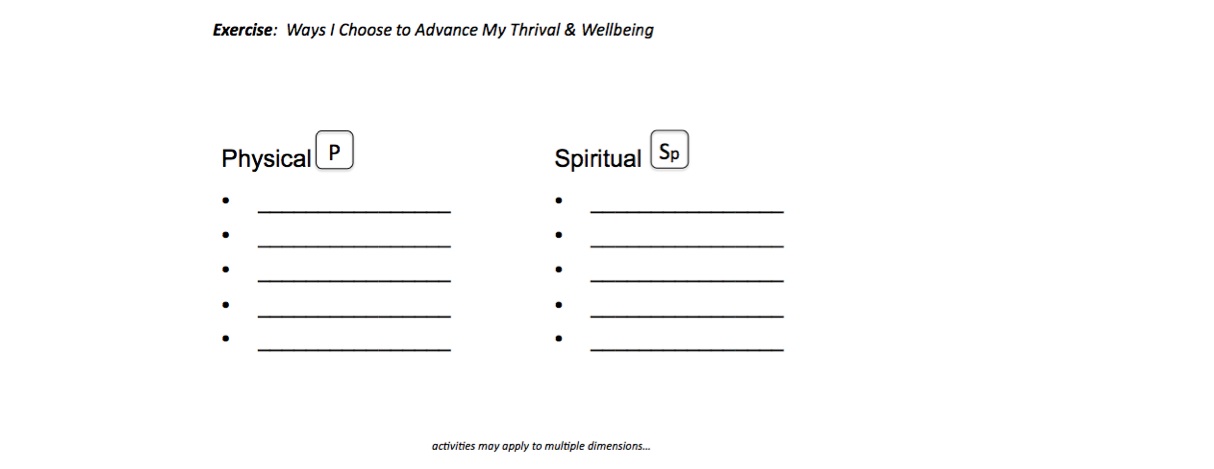
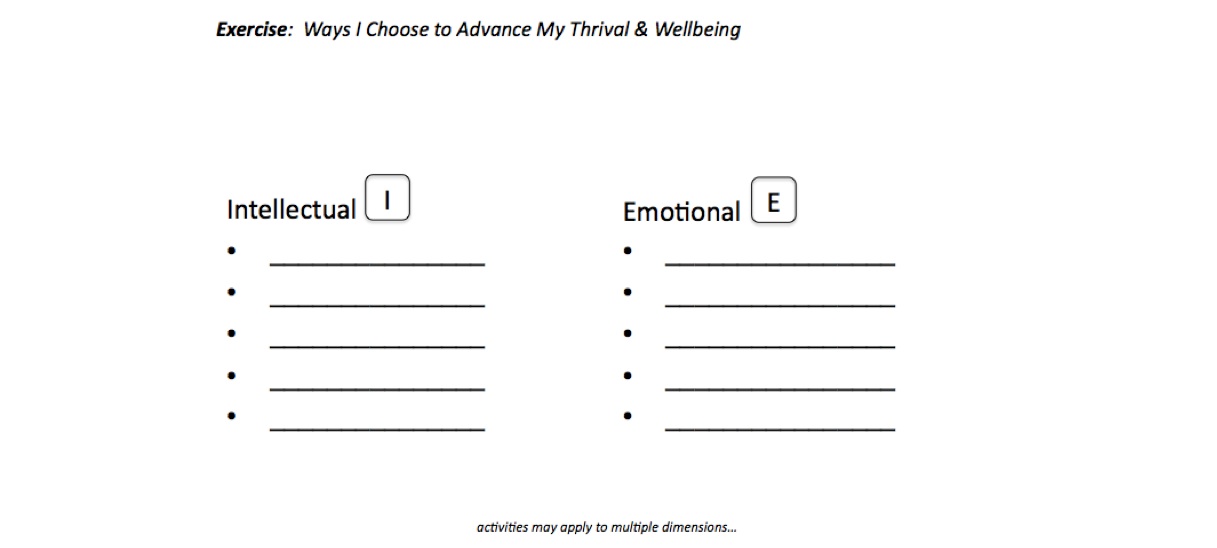
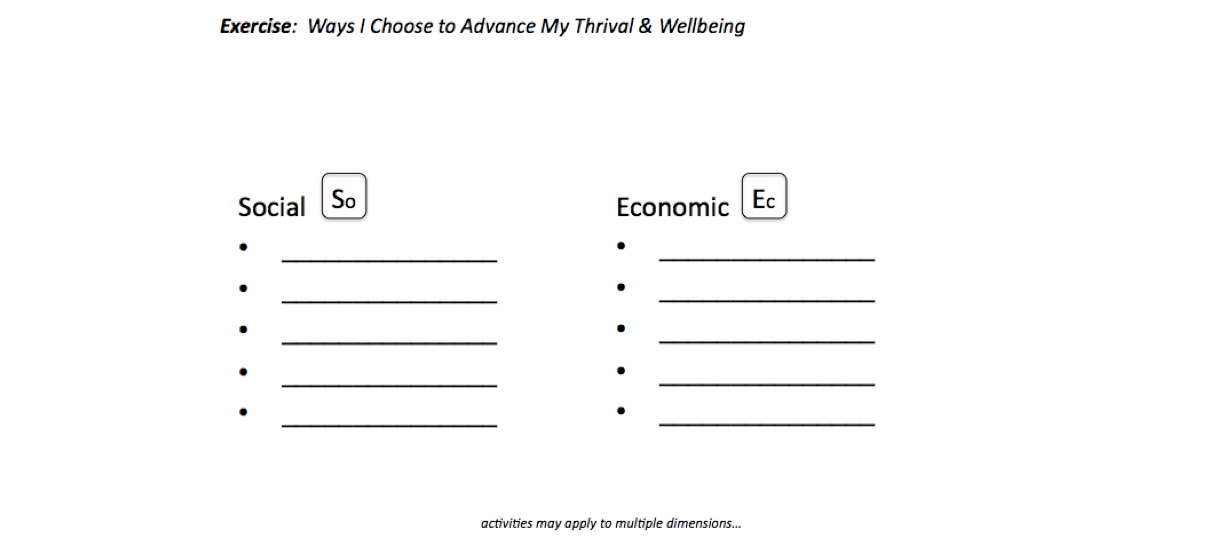
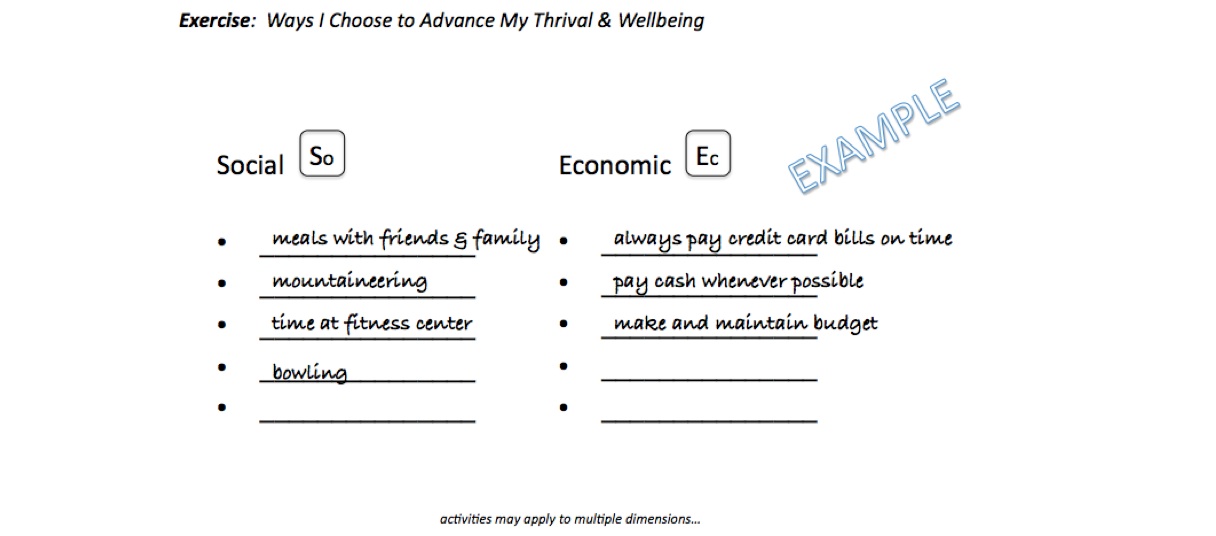
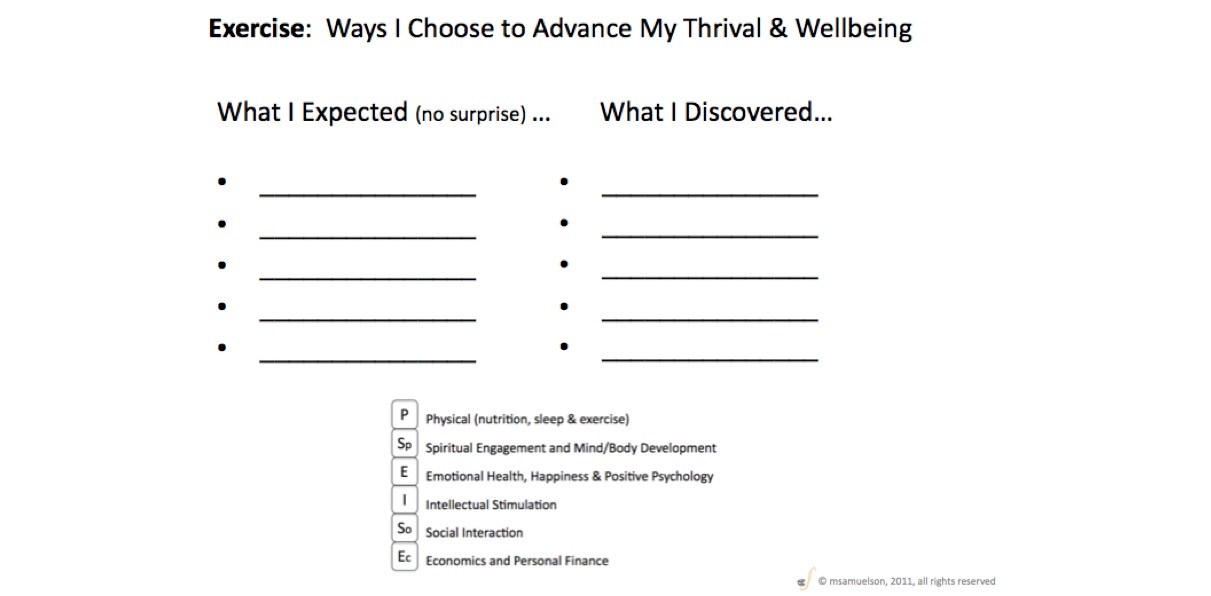
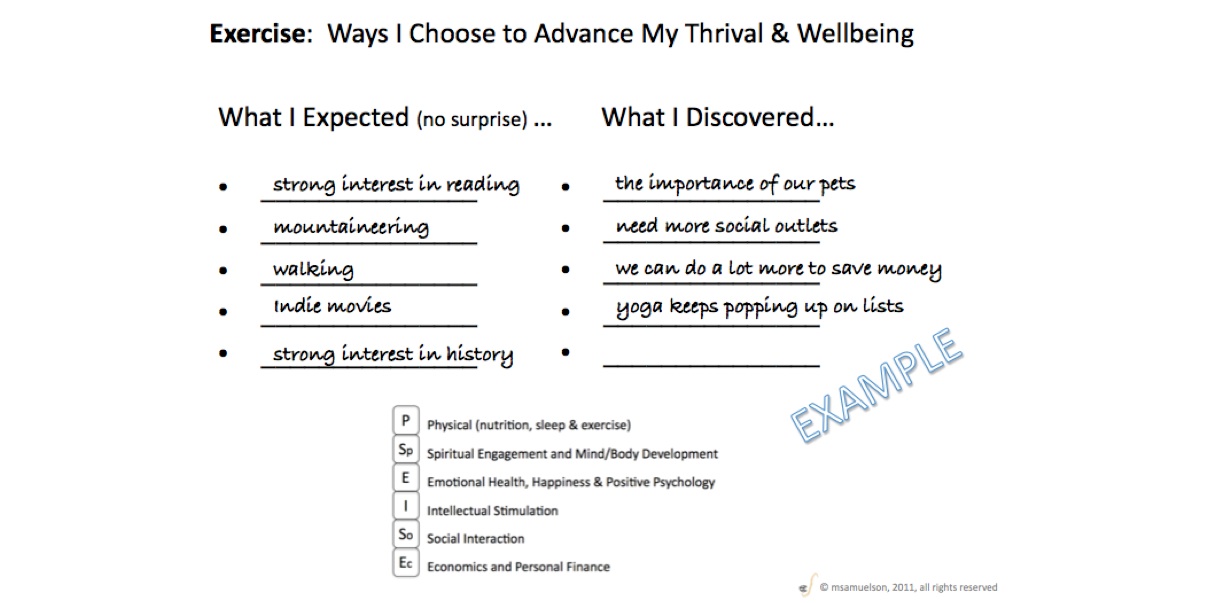
In the following exercise please list those activities that appeal to you in each of the “Six Dimensions of Wellness and Thrival.”
– MH Samuelson
Definition of Terms & Sectors:
Physical (nutrition, sleep & exercise) – health professionals can objectively introduce the newest USDA food guidelines, introduce you to the five food groups and explain the difference between healthy and unhealthy oils, but they can’t govern your personal preference for the preparation, presentation, taste and texture. They can tell you to eat dark green vegetables, but you have to decide if you like broccoli, romaine lettuce or raw baby spinach. They can also objectively point out the importance of following exercise guidelines from the American College of Sports Medicine and the American Heart Association, but you and your doctor have to decide if it will be moderate for 30 minutes a day, five days a week OR vigorous for 20 minutes a day, three days a week. And, while an educator can show you a whole host of strength-training exercises, you will have to decide which 10 exercises you enjoy enough to do eight – twelve repetitions, twice a week.
Intellectual Stimulation – A health educator can objectively discuss the latest findings regarding brain plasticity and show you the brain “use it or lose it” research, but you have to choose activities that not only stimulate your brain, you also enjoy! Chess may light up neurons, but it may also drive you crazy! Is it Mozart? How about the classics or a decent comic book? Learning a language works at any time but so does learning a new musical instrument. So, what language? What instrument? How about crossword puzzles or Sudoku? Professionals can tell you to stay engaged and to continue learning new things, but only you can make the personal choices that will keep it fun and encourage you to be a student until your dying day.
Emotional Health, Happiness & Positive Psychology – A health educator can objectively guide you to research touting the importance of nurturing your emotional health and the importance of striving to be happy (make that happier). Tal Ben-Shahar from Harvard, Martin Seligman, author of “Authentic Happiness” and the Dalai Lama are among the many that will show you the evidence and present logical arguments that support positive psychology. The experts and the literature can explain the “whys” and the “hows,” but YOU have to look for, identify and protect what aids your emotional health and makes you happy (a happier you makes for happier people around you…). Is it time with your pet? How about time with kids and family? Maybe — for you — emotional health is buoyed whenever you complete your daily “To Do” list or spend time outside playing in the sun. You know what makes you happy so plan time each day to do it!
Spiritual Engagement and Mind/Body Development – A health educator can tell you that spiritual growth puts life in context, it gives meaning to your every thought and action. Regardless of where you find it — bricks and mortar, open fields, tops of mountains, desert canyons, ocean waves, or cuddled inside a child’s laugh, spiritual essence is all around us. As the poem states, “[Spirituality is] forever present without the need of definition, transparent to some, blindingly radiant to others, existing without beckon; eternally ours….”
Christ, Moses, Buda, Mohammad, Lao Tzu, Gandhi, Mother Teresa, Winnie the Pooh and Piglet also remind us of the importance of finding and following the path to happiness and freedom for ourselves and all beings. But, where is your path? How do you know when you are traveling the right road? Where does it lead, today? Tomorrow? Tough questions. Once again, only you will know (know already) what actions, activities, people, places, thoughts, and dreams bring peace to your spirit and strength to your body.
Social Interaction – A health educator can tell you that John Donne nailed it when he wrote: “No man is an Island, entire of itself; every man is a piece of the Continent, a part of the main; if a clod be washed away by the sea, Europe is the less, as well as if a promontory were, as well as if a manor of thy friends or of thine own were; any man’s death diminishes me, because I am involved in Mankind; And, therefore, never send to know for whom the bell tolls; It tolls for thee.”
Though written in the early 17th century, the sentiment and fact remain true. We need each other for our safety, economic growth, advancement of science and art and for our emotional and physical well-being…our wellness.
Health educators can show you empirical information all day long that points to the importance of staying connected with others, but they can’t tell you what type of human contact is best for you! Join a square dancing club? How about a bowling league, church choir or a softball team? Maybe you’re quiet and shy and would prefer to remain anonymous. If that is the case, how about using email, a chat forum for your favorite hobby or a social network like “Facebook.”
Economics and Personal Finances – A health educator can tell you that a failing economy and poor personal financial management are a tremendous source of illness-causing stress, but you have to know your personal danger signals and take appropriate prevention measures. A financial advisor can tell you about the hazards of a balloon mortgage and the dangers of escalating interest rates on credit cards, but you have to accept responsibility for risky investments, reckless spending and payment defaults.
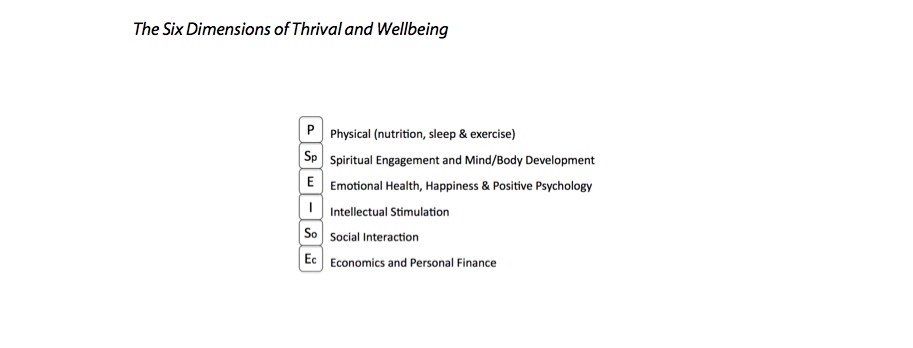
The six dimensions of thrival and wellbeing:
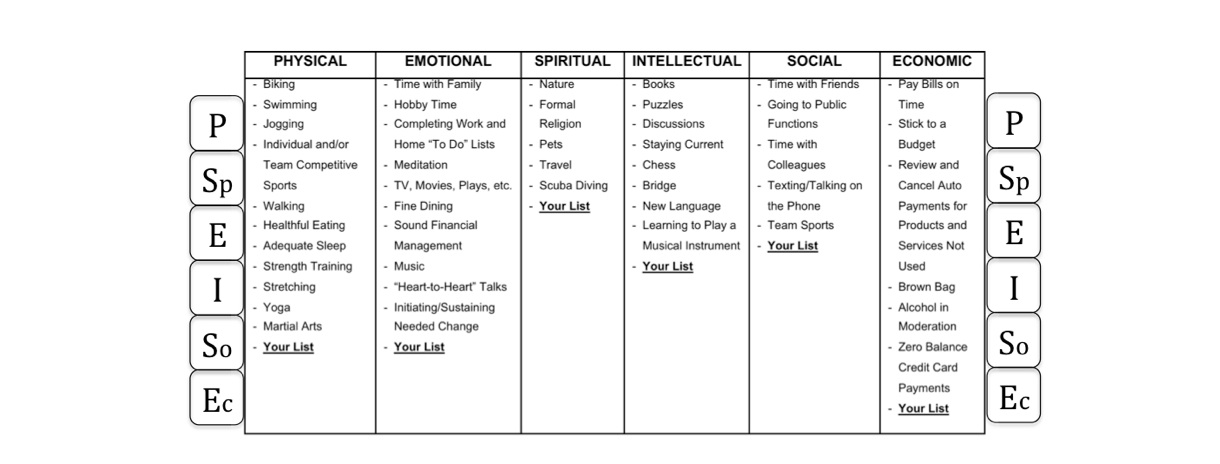
Here are possible elements and activities …
Keep in mind the fact that one element may fit into several sectors. For example — for many individuals — exercise scores in many sectors. A sunrise/sunset bike ride may trigger spiritual satisfaction; walking with your family may earn social, emotional, AND physical marks. Swimming laps and light jogging is known to stimulate the release of nitric oxide triggering “eureka” moments that lead to problem solving (intellectual). Playing Frisbee in the park with your dog may fit into physical, emotional, spiritual and social. You get the point … it’s up to you!
well·ness,\ˈwel-nəs\: a dynamic objective and subjective progression toward a state of complete physical, intellectual, emotional, spiritual, economic and social well-being and not merely the absence of disease or infirmity. Incremental improvements can occur from pre-conception up to and including a person’s last breath
– MH Samuelson
Position Statement:
Wellness is located at the intersection of Contentment and Aspiration. To live there, you must first choose to move out of the Village of Someday.
– MH Samuelson
NOTE
What follows is Part II of a seven-part essay on work/life balance. While the basic information applies to everyone who accepts pay in exchange for effort, the focus of this essay is on the skills needed to emotionally, physically, spiritually, intellectually, socially and financially thrive in a fast-paced, early stage, entrepreneurial and intrapreneurial venture.
“Each of you is perfect the way you are…and, you could use a little improvement.”
– Shunryu Suzuki
What is my purpose in life, what do I choose to stand for? Age old question, “Why was I born?” “What is My Purpose?”
Let’s start by developing a first draft of a personal mission statement. Don’t worry about the fine-tuning. For now, just write what comes to mind. To help you get started, here’s an example:
“My personal mission is to progressively and consistently achieve measurably higher levels of physical, emotional, intellectual, social and spiritual awareness by living a life of integrity, curiosity, authenticity, compassion and dedication to the collective needs of all beings. And, to assist others in doing likewise.”
A bit lofty, perhaps, but a personal mission statement should reflect an ideal that you aspire to, something grand, an oath proudly pledged. It needs to be straightforward enough to always recall, subjectively as well as objectively measurable and dynamic to the extent that it is continually evolving.
Another example:
“My personal mission is to be a constant and continuous positive role model for my children and grandchildren. I will demonstrate this by my acts, my deeds, and—most important—my intentions.”
Okay, your turn.
“My personal mission is to …
Now, what is your company’s mission statement? Are the messages in sync? If not, you are heading for trouble. It’s pure hubris (look it up) to suggest that it won’t impact you in some negative fashion.
At the Health and Wellness Institute, our mission was to:
“… progressively and consistently achieve measurably higher levels of physical, emotional, intellectual, social and spiritual awareness by living a life of integrity, curiosity, authenticity, compassion and dedication to the collective needs of all beings. And, to profitably assist others in doing likewise.”
The only difference between my personal mission and the mission of the company that I was charged with managing and growing was the introduction of the word, “profit.” Not a small difference, you might be thinking, and, you are correct—no margin…no mission—but the general philosophy is in perfect harmony.
Okay, your turn.
My company’s mission is to…
Is this in harmony with your personal mission statement?
Coming Up:
Part III: How Do I Currently Choose to Advance My Thrival and Wellbeing?
Part IV: If life Gave Me a “Do Over” What Would I Choose to Do Over?
Part V: Once I Choose a Goal, What’s the Likelihood that I’ll Stay with It?
Part VI: How Do I Validate and Support the Goals that I Choose?
well·ness,\ˈwel-nəs\: a dynamic objective and subjective progression toward a state of complete physical, intellectual, emotional, spiritual, economic and social well-being and not merely the absence of disease or infirmity. Incremental improvements can occur from pre-conception up to and including a person’s last breath
– MH Samuelson
Position Statement:
Wellness is located at the intersection of Contentment and Aspiration. To live there, you must first choose to move out of the Village of Someday.
– MH Samuelson
NOTE
What follows is Part I of a seven-part essay on work/life balance. While the basic information applies to everyone who accepts pay in exchange for effort, the focus of this essay is on the skills needed to emotionally, physically, spiritually, intellectually, socially and financially thrive in a fast-paced, early stage, entrepreneurial and intrapreneurial venture.
Because we are human we do not always do what our mothers taught us to do. We make mistakes. We slip. Sometimes we feel guilty, sad and remorseful. This is followed by a strong commitment to change; to get back on the right path, to do all those things that mom, our first-grade teacher, Captain Kangaroo, Bert & Ernie, Mr. Rogers and Oprah told us to do. Unfortunately — just like when on a bike path — once we slip off we slip off our designed life path we tend to make deeper and deeper grooves in the soft grass and mud. If we stay too long the grooves just get deeper until we find ourselves in someone else’s tracks; someone who slipped off the path long before we came along. Without fast action, we quickly adapt to this new trail. It seems so much easier to just continue along in the mud. The problem is that we know we are in the mud and that we would be much safer if we could break through the rut and get back on the stable road. However, when we try to leave the sloppy and increasingly dangerous trail we are intimidated by the bumps as we smack up against the groove’s edge. So, we settle back into the rut (we’ll try again, later). We lack the courage, strength or will to risk the initial jar so we stay where we are.
Such is life both on and off a bike path. The difference between life and a bike path is that, on the life path, there are plenty of people willing and anxious to tell you what’s good for you — what you need to do to live a healthy, happy, and prosperous life — to get back on the right path. Parents, teachers, priests, rabbis, monks, brahmas, mullahs, your Aunt Betty, Dr. Phil and the next-door-neighbor stand ready to offer (push) advice your way. Mostly, this advice is well intentioned, but it is often general in scope with little or no personal relevance.
The Science of Life and the Art of Living
Any newsstand magazine, professional website or internet blog can give you a broad wellness formula made up of good sense tips (mom told you all of this a long time ago) like eat healthy foods, get plenty of sleep, stay away from tobacco, drink alcohol moderately or not at all, exercise regularly, spend time with family and friends, read a good book, see your doctor and dentist annually, wear your seat belt, believe in a higher power and stay away from a steady diet of cable news.
The science of life is general and objective. Foregoing bad genes and catastrophic events, evidence shows that a life accented by a healthy blend of proper nutrition, physical activity, rest & recovery, intellectual stimulation, emotional support, spiritual engagement, economic security and social interaction tends to be long and relatively free from illness and infirmity. Science can show you how to construct a strong skeleton but YOU have to lay down the muscle and tease out the connective tissue that makes your unique system work, for you.
So…What Do YOU Want?
There are countless “How To…” books outlining the objective science of life complete with full-color templates. But, only YOU can explore, discover, design and nurture the unique, subjective, deeply personal, art of living your life.
The question is: What do YOU want? Where do YOU want to go? What predictably triggers and sustains those moments when you feel truly happy and satisfied with the life you’re living? Is it yoga or deep breathing exercises? How about The Bible, The Koran, The Torah, or “The Four Noble Truths?” Is it truly better in the Bahamas … and does it simply take a trip to Jamaica to feel all right?
Perhaps, for you, well-being — high performance wellness — kicks into gear when you read a good book, spend time with your kids, go the movies, buy gifts for your grandchildren, drink a cold beer on a hot summer day, watch television or work till dawn on a project that comes to life and tickles you each time you give it your undivided attention? For me, every few years, it’s a quiet far-far-away mountaintop, exhausted, sleeping alone in a tent surrounded by strangers who quickly become forever-memory friends. For my wife it was once the thrill of climbing out of a perfectly good airplane, hanging from the wing strut, letting go, and floating through the sky (YIKES!).
How about you? Of course you want to increase and sustain your life satisfaction but first you must WAKE UP! You must become AWARE and take inventory of what brings meaning to your life, today. You must open all your senses and pay attention.
Life Satisfaction & The Art of Living
As stated above: Because we are human we do not always do what our mothers taught us to do. We make mistakes. We slip. However — the good news — because we are human, we can also symbolize, anticipate, learn, self-regulate and self-reflect.
Because we are human, we can change.
Just maybe you fell off that life path because your wheel wasn’t balanced properly — for you! Maybe you fell off the life path because not only was the wheel balanced for someone else … you may have been on someone else’s life path, as well. Time to get on your own path and balance your own wheel!
Designing and Balancing Your Own Life Wheel
Think of life as a wheel divided into six overlapping sectors: social, spiritual, intellectual, physical, economic and emotional. Each sector is made up of elements (spokes) that support and strengthen the wheel. They are both dependent and independent aspects of what makes you, you.
On a bicycle wheel, the spokes pull the outer rim toward the hub. Likewise, on your life wheel, the elements and activities (spokes) connect and pull the outer rim — the universe — toward you. YOU are the hub of your universe.
The responsibility for selecting, securing and maintaining sector elements — the spokes — is yours. Happiness (life satisfaction) is influenced by the integrity of each spoke. To maintain high life satisfaction you need to routinely check and, as needed, adjust the composition of each spoke as well as the overall balance of your life wheel.
Should you choose to advance your high performance wellness, the sections that follow will help you awaken to what is meaningful. Not just what your head says is meaningful but—way more important—what your belly and heart says is important, those things that touch your soul and shake your bones.
Caution: This journey is not to be taken lightly.
Awakening brings acute awareness, accountability and a profound understanding of choice. No longer will you readily assume the role of victim when confronted with obstacles, disruption and hardship. Nor will you will routinely subjugate your joy and passion for the interest of others. You will instead own and be responsible for the moments of your life, all of them. Clarity lifts the gauze that both protects and restricts what you see and feel.
Do You Choose to Wake Up and Balance Your Own Wheel?
Coming Up:
Part II: What is My Mission in Life, What Do I Choose to Stand For?
Part III: How Do I Currently Choose to Advance My Thrival and Wellbeing?
Part IV: If life Gave Me a “Do Over” What Would I Choose to Do Over?
Part V: Once I Choose a Goal, What’s the Likelihood that I’ll Stay with It?
Part VI: How Do I Validate and Support the Goals that I Choose?
well·ness,\ˈwel-nəs\: a dynamic objective and subjective progression toward a state of complete physical, intellectual, emotional, spiritual, economic and social well-being and not merely the absence of disease or infirmity. Incremental improvements can occur from pre-conception up to and including a person’s last breath
– MH Samuelson
Position Statement:
Wellness is located at the intersection of Contentment and Aspiration. To live there, you must first choose to move out of the Village of Someday.
NOTE
What follows is a seven-part essay on work/life balance. While the basic information applies to everyone who accepts pay in exchange for effort, the focus of this essay is on the skills needed to emotionally, physically, spiritually, intellectually, socially and financially thrive in a fast-paced, early stage, entrepreneurial and intrapreneurial venture.
Once Upon a Time…
…when I was the CEO of the Health and Wellness Institute, I had this photo blown up and hung in our main conference room. Let me tell you why.
Back in 2001, I was on a 14-day trek that would take me from Lukla to the Mt. Everest basecamp and the summit of Mt. Kalapathar, in Nepal. And, no, I didn’t summit Mt. Everest, nor did I attempt to do so. The trek to basecamp and the pre-dawn scramble up Kalapathar was plenty enough challenge and quest for me, thank you. The mountain and glacier views were spectacular, of course, but it was Nepalese and Tibetan cultures and people that made the trip awesome (true sense), a true once-in-a-lifetime adventure!
This is not the time or place to tell you about all of my adventures on the road to Mt. Everest but it is, in the spirit of The Reader’s Digest, the perfect place to tell you about one of “My Most Unforgettable” characters.
Tenzing is the name of the young man pictured, above. I took this picture after he rested on his 27 mile journey from Tingri, a small border village in Tibet, to Namche Bazaar, a trading center in the High Kumbu region of Nepal. The basket of blankets—with his gear on top—weighed approximately 50 kilos (~110 lbs).
Checkout the moonscape. Tenzing was fifteen years old. He was wearing flip-flops.
When I met him, he smiled, bowed, and wished me, “Namaste.” While we talked (translated by Ang Nima Sherpa) he smiled and laughed. As he started back on his journey he smiled, bowed, wished me “Namaste,” and started singing.
Tenzing didn’t know he was miserable. He didn’t know he was working. In the language of the High Kumbu there is no word for “work.” There is only life and living. Trading blankets is what he did, his home was wherever he happened to be at the moment (Buddhist), his community was whomever he met on his journey. The only balance he was concerned about was strapped to his forehead.
“Work/Life Balance” is a western construct. It is both a blessing and a curse birthed from affluence and comfort. It suggests a paradox of duality; a dichotomy, a plural world of singular opposites that we must identify, separate, divvy and balance. What nonsense. Yet, it is our nonsense so we must deal with it. And, so we will.
The underlining theme of this article is “Choice.” And, yes, you do have a choice. We may not be able to control circumstance, but we can control choice.
This article is divided into seven parts and includes some opportunities for self-reflection. The reflection is, of course, up to you. Remember, it’s all about choice. You can choose to be like Tenzing and whistle and sing while you worklive or you can moan and complain. Like I said, it’s up to you.
Coming Up:
Part I: First, I Must Choose to Wake Up!
Part II: What is My Mission in Life, What Do I Choose to Stand For?
Part III: How Do I Currently Choose to Advance My Thrival and Wellbeing?
Part IV: If life Gave Me a “Do Over” What Would I Choose to Do Over?
Part V: Once I Choose a Goal, What’s the Likelihood that I’ll Stay with It?
Part VI: How Do I Validate and Support the Goals that I Choose?
“The single biggest problem in communication is the illusion that it has taken place.”
– Bernard Shaw
NOTE
What follows is the summary the essay on corporate communication. While the basic information has universal application, the focus of this series is on the communication concerns of fast-paced, early stage, entrepreneurial and intrapreneuial ventures.
Position Statement
Business (life) means building and maintaining relationships.
So What? So What? I’ll tell you So What. Wars are fought, relationship destroyed, opportunities are missed and lives are lost due to misunderstandings, confusion, unintentional insults, and perceived—and intended—mixed messages. That’s So What…
In business, oblique-speak (“BS,” “Blowing Smoke,” Wink-Wink-Nudge-Nudge”) is a manager’s downfall. Establish a relationship of trust and speak clearly leaving little or no room for misinterpretation. If unsure, have the person your addressing give their understanding of what you just told them. And, remember, lying by omission is deceit in its most cowardly form.
Unless immediately informed to the contrary, every employee must come to work every day knowing they are Secure, Accepted as an on-going member of the team, and that they are Respected for their knowledge and contribution to the company mission. Once doubt occurs in any of these three default conditions, communication begins to shut down. An organization without a SAR culture invites a reduction in productivity, an increase in turnover, stress-related absences, heightened presenteeism, and reduced staff morale.
Tune into the concern behind the question, stay away from hyperbole and don’t confuse connectivity with communication.
In business (and life) the preferred order of personal interaction is as follows:
In-Person Face-to-Face
Electronic Face-to-Face
Telephone
Video Message
Audio Message
Descriptive Email
Text Message
Conflict with integrity is critical if you are to successfully mine all of the talent in your shop. Irritation produces pearls and without disruption there is no innovation. However, without a SAR culture, conflict can destroy your company.
“The single biggest problem in communication is the illusion that it has taken place.”
– Bernard Shaw
NOTE
What follows is Part III of a four-part essay on corporate communication. While the basic information has universal application, the focus is on the communication concerns of fast-paced, early stage, entrepreneurial and intrapreneuial ventures.
Position Statement
Business (life) means building and maintaining relationships.
“Conflict is the gadfly of thought. It stirs us to observation and memory. It instigates to invention. It shocks us out of sheep-like passivity…”
– John Dewy
Conflict as an Asset
When most people think of conflict, the following words and conditions come to mind:
fight
lose
anger
control
pain
hate
war
loss
impasse
bad
destruction
wrongdoing
fear
confrontation
mistake
avoid
Well, contrary to what you may have heard or thought, conflict is good, yes, good.
Irritation produces pearls and without disruption there is no innovation. However—and this is a very important “however”…minus integrity, constructed on blocks of honorable intention, a secure-accept-respect (SAR) culture, and considered thought, conflict destroys.
So, as you can see, at the workplace, we are talking about a very fine line that separates productivity and empowerment from chaos and suppression. This condition defines the classic approach-avoidance dilemma. As a manager do I allow and encourage differences of opinion, open discussion, healthy skepticism and exploration? Or, do I run a strict top-down organization where “I dictate…You follow” is both motto and practice?
The sad fact is that many, if not most, organizations wave a banner that shouts collaboration and invites input while placing an ever-stronger chokehold on constructive opposition and disagreement. Instead of viewing conflict as opportunity, a closed-minded autocrat views conflict as a threat and either avoids or stomps it out, quickly. What a shame.
By the way, yes, there are times when leadership must make tough decisions and point the way, despite opposing views—even if those views are of the majority. That’s why thrones are built for one person. Fine. Good. I’m all for it. But if leadership falsely advertises a management style that embraces honest input and open discussion only to punish those who present cross-aisle views, shame on them. Not only is this deception immoral (call it what it is) it wastes time and hurts the company in the long run. High-integrity conflict is good.
Traditional Approaches to conflict
Conquest
Once bullying, dominance, and manipulations are used, it is difficult to view the person’s power in any other way.
Relationship suffers because the dominated person is reluctant to use innate talents and acquired skills.
Passive/aggressive actions eventually spring from the subverted individual.
Avoidance
Mistakenly suggests that all conflict is bad (see above).
Denies opportunities to clarify positions and clear up potential misunderstandings.
Implies acceptance of behavior thus enabling the individual to continue on a potentially dangerous or disruptive path.
Band-Aid
Creates an illusion of permanence.
Avoids the core work of resolution and establishes a set behavioral approach to conflict.
The “quick-fixer” is reinforced for putting out the fire but the embers continue to burn—creating a culture of crisis management. (BTW, if you have someone on your team who is great at putting out fires, check their desk drawers for matches…).
Role Player
Rigid role assignments foster myopic solutions centered on power.
Subordinate member of relationship hesitates to contribute beyond his/her assigned role.
Can create an on-going adversarial relationship.
Bargaining
Often focus is on numbers and objects instead of personal value.
Can develop into a carry-over adversarial relationship based on “winning” and “losing.”
Stronger or more articulate negotiator wins not on merit and value but verbal skills—can damage relationship in the long-term.
A New View of Conflict
Instead of always…
A disruption, negative experience, error, or mistake
Perhaps…
An outgrowth of diversity leading to mutual growth and improved friendship
Instead of always…
An all-consuming battle of self-interests or desires
Perhaps…
A reflection of one or two aspects of a total relationship
Instead of always…
An isolated event we use to define the entire relationship
Perhaps…
An opportunity for clarification in a long-term relationship
A Partnership Process
Conflict enhancement and relationship building requires that you focus on needs, perceptions, power, values and principles, feelings and emotions, and internal conflicts.
WE not I vs. you…
Conflicts must be considered in context.
Honest discussion of disagreements strengthens relationships but BOTH parties must participate.
Ten Steps to Conflict Enhancement and Relationship Building: A Formula
Look to the Future and Learn from the Past
Generate Options
Develop Realistic Stepping Stones to Action
Make Mutual-Benefit Agreements
Celebrate Diversity
Crate an Effective Atmosphere (SAR management)
Clarify Perceptions
Focus on Individual and Shared Needs
Build Shared Positive Power
NO OBLIQUE-SPEAK!
Keep in mind the fact that how we understand conflict influences how we develop and maintain relationships. Recognize and celebrate the fact that honorable conflict is an outgrowth of diversity and differences. Both productive and destructive conflicts involve emotions, values, and principles as much as needs and desires and that …
how well you handle your internal personal conflicts will often direct how well you develop and maintain relationships.
“The single biggest problem in communication is the illusion that it has taken place.”
– Bernard Shaw
NOTE
What follows is Part II of a four-part essay on corporate communication. While the basic information has universal application, the focus is on the communication concerns of fast-paced, early stage, entrepreneurial and intrapreneurial ventures.
Position Statement
Business (life) Means Building and Maintaining Relationships
As a university lecturer, mentor and trainer of hundreds of health promotion professionals, I always stress the importance of C4 (crystal clear communication is critical). The order of preference for business—and personal—communication is:
In-Person Face-to-Face
Electronic Face-to-Face (e.g., FaceTime, Skype)
Telephone
Video Message
Audio Message
Descriptive Email
Text Messages (Think 140 Characters or Less)
In-Person Face-to-Face
Of course, you’ve never done this but we all know tales of people one office apart who text or send emails instead of getting off their butts and walking ten steps. Or, even worse, people in the same room who text one another. Yikes! What ever happened—now, I’m sounding like my father—to shaking a hand, looking someone in the eye, and saying whatever it is you need to say? As mentioned earlier, language goes way beyond written or even spoken words. As the saying goes, “Eyes are windows to the soul.” Whenever possible—good news, bad news or just chatting—make it in-person, face-to-face.
Electronic Face-to-Face
While not the same as being there, today’s technology permits the next best thing, video chats. Whether it’s a client in London or my granddaughter in Providence, they are just a click away. I can see their eyes, hear all of the voice variations, and even catch non-verbal facial expressions and a bit of body language. In other words, we get to communicate. Pretty cool…
Telephone
We’re moving down the communication scale but still doing pretty good. Gone our the days of party-lines, mortgage-your-house-long-distance charges, and waiting outside a phone booth (with a pocket full of change). In this era of affordable cell phones and manageable rates there is no reason for not doing both business—as well as social catch-ups—in real-time.
Video Message
Video messages, like the ones I use on my blog, are fine for summaries, quick hellos, and for introducing articles, business documents, and news events. The recipient gets to see the author and the author is able to enhance the message using visual and auditory cues. The key is to keep them as short as possible, preferably less than five minutes and certainly no more than ten. There’s a reason why broadcast television breaks every twelve minutes and why commercial messages are sold in 5, 10, 15 and 30 second segments (60 also but these are increasingly rare).
Audio Message
Not very intimate but, at times, a pretty good alternative to real-time. If you simply want to convey information with affect—and you don’t need an immediate response—an audio message works great. However if you are leaving business or personal messages at 3am because you want to make sure you don’t have a live connection, I suggest you figure out what you are afraid of. And, oh yes, you are afraid of something. Like I said, figure it out…
Descriptive Email
Other than as a way of distributing pure information—who, what, when, where, why and how much—or, as a way to transmit business documents, video or audio messages, email should be avoided. If you are shooting for a humorous, sarcastic or sardonic tone, or, if you find the need to frequently bold, italicize, or exclaim!, business email is the WRONG place to do it. Most people simply can’t pull it off (some can…but not many) and the result can range from confusion and annoyance all the way to anger and loss of business and business relationships.
Text Messages
Other than quick hits like…
“Meeting time changed to 2:00.”
“Just leaving the office.”
“Don’t forget the J&J report.”
“Call me ASAP.”
“Where the hell are you?”
“On my way home I’ll get milk , bread, and (okay) beer…looks like snow!”
…and other easily understood one-liners, stay away from text messages. They have no place in business communications. This is particularly the case with acronyms and emoticons. Don’t use them because OMG IGWS I won’t be HOYEW! ;-(
Coming Up…
Part III: Building and Maintaining Relationships – A Formula
“The single biggest problem in communication is the illusion that it has taken place.”
– Bernard Shaw
NOTE
What follows is Part I of a four-part essay on corporate communication. While the basic information has universal application, the focus is on the communication concerns of fast-paced, early stage, entrepreneurial and intrapreneurial ventures.
Position Statement
Business (life) Means Building and Maintaining Relationships
1. Create a Culture of Security, Acceptance, and Respect (SAR)
When I was completing a master’s degree in guidance and counseling from the University of Michigan School of Education—a long time ago—it was drilled into our heads that, rather than truly listen when spoken to, most people half listen while they rehearse what they’re going to say when it’s their turn to speak. As a result, the subtleties of language are often missed. Things that go unnoticed, like a raised eyebrow, a smirk, a shoulder shrug, a shoe scuff, and darting eyes—the italics of conversation—are as meaningful and defining as a shout, a cry, or a whisper. Miss them and you miss the meaning behind the words. Throw on top of that our reluctance to use unvarnished and to-the-point language and you can see the truth in Shaw’s quote, above.
Trust is an Issue
There is a nurture vs. nature argument here that I’ll skip for now. Regardless of origin, we, as a society (Species?), tend to be skeptical and, increasingly, cynical. We question what we hear—and sometimes what we see. “What’s the angle?” “I’m not sure she actually meant what she said.” “Look me in the eye and say that, again.” “Ummm, I wonder.” And, who can ever forget the battle of wits in the poison scene between Vizzini and The Man in Black from the movie, “Princess Bride.” When acceptance, respect and the overall security of a relationship are questioned, we, like Vizzini and The Man in Black, think, plan and act according to our interpretation of true intentions…face value no longer has much value.
Darwinian or not, in business, particularly in a start-up venture, it is imperative that all parties truly trust one another. Management must speak clearly and directly at all times AND encourage all employees to do likewise. Shoestring budgets and—not-long-enough—sixty-hour weeks permit only the thinnest margin of error. Let me make it very clear that this does not suggest that bullying, rudeness, disrespectful or petulant behavior is excusable; that is never the case. The default must be that:
our relationship is solid and secure
we accept each other as individuals
we respect each other’s talents and contributions
THE C4 PLEDGE
I HEREBY PLEADGE THAT I WILL IMMEDIATELY INFORM YOU IF AND WHEN ONE OR MORE OF THESE VITAL CONDITIONS ARE CHALLENGED
Signed: ________________________
The Tale of Two Employees
Nobody Ever Told Me…
Let me tell you a sad story. When I was asked to build a company within a company—to be an intrapreneur—I was given a considerable budget and a fair amount of freedom to assemble a quality “A” team. I could build the team by recruiting outside or, if I chose, I could interview and make offers to candidates currently employed by the parent company. Human Resources, on the lookout for possible matches, suggested one particular individual from the parent pool. The individual had nineteen years of service with a stellar performance review history. I had met this person briefly and he seemed like a good guy but the nature of the job was technical and a bit out of my scope so I leaned heavily on the impressions of others.
When I mentioned this candidate to the CEO of the parent company, he said, “Oh, you don’t want him. He’s a mail-it-in kinda’ guy. Just does the bare minimum and checks out.” When I spoke with his immediate supervisor, I got a similar response. So, when it came time for me to formally interview this person, I told him what I’d heard (protecting the sources). He was devastated. In all the time on the job he thought he was doing a fine—if not exemplary—job. Oblique speak at its worse. From what I could tell, he was a fine person with above average intelligence. With the right coaching and with honest feedback he may have moved into a high middle management position. Instead, within a couple years, when the economy tanked—and layoffs were inevitable—he was gone.
Two things were happening here. One, my guess is that he, at some level, knew he wasn’t performing at his best but put the gear in cruise figuring all was good with the brass. The other thing was a culture of “nice guy” where nobody wanted to criticize the work of someone who, while maybe not destined for the C Suite, was “good enough.” He was accepted as a person but his work was not respected and he was on shaky ground for years; unfortunately, nobody told him. It was a case of pure conflict avoidance. The result hurt both the company—he was capable of so much more—and the individual who never got the needed kick in the butt needed to move himself out of cruise and into passing gear.
I Get By with a Little Help from My Friends…
In another case with a happier ending, let me tell you this story. In the field of wellness and health promotion I’ve encountered scores of really good people but only dozens of business-ready people. They—the nice but unconsciously incompetent group—need molding, mentoring, coaching and opportunities to both fail and succeed. Most listen well, respond quickly, rarely make the same mistake twice and do just fine. And, then there are those who, while talented, tend to wander off into deep water a little too often.
One such young man was having a challenge with authority and, it appeared, women supervisors in particular. His insubordination was reported up the chain of command and, after his boss conferred with her boss, the employee was place on a Performance Improvement Plan, a PIP. Having been schooled on the fine points of Secure-Accept-Respect management (SAR), it was explained to the employee that he was respected for his field knowledge and for his overall contribution to the team but that his attitude and failure to carry out instructions from his supervisor was unacceptable. Furthermore, it was made perfectly clear that failure to rectify the situation would result in probation and, potentially, dismissal. MOST important the PIP team, which included him, designed SMART goals that, if met, would put him back on track.
The review process uncovered cultural factors on both sides that helped explain—but not justify—his behavior. The process also revealed the extent of his supervisor’s frustration. To complicate matters, the supervisor, a warm, compassionate, quintessential health promotion professional, ranked very high on the OBLIQUE-SPEAK scale. Her instructions were riddled with ambiguity and qualifiers. For example, instead of saying, “Be at Sharp Mechanics on Tuesday no later than 10:00 sharp to begin screenings. And, make sure to complete no less than 20 before heading back to the office at noon.” She was more apt to say, “If you would, please, try your best to start the screenings around 10:00, do the best that you can and I’ll see you when you return to the office. My guess is that it shouldn’t take you more than a couple hours to complete 20 screenings.” When he got back to the office at 12:30 after completing 15 screenings beginning at 10:30 she was furious and he was confused. She thought she was very clear with her instructions and he thought he was following her instructions to the letter.
In this case the issue was resolved and the employee went on to become a truly exemplary member of the corporate team. Why? Because of 5 critical steps:
The issue was reported early
The employee received a SAR review
A collective effort determined the source of the problem
A PIP was generated and agreed upon by all parties
Both supervisor and employee received training on non-verbal communication and conflict management.
In the first case, the employee was blind-sided and everyone lost. In the second case, because of a SAR culture, everyone won. You choose…
2. Practice No-Oblique Speak
When I was a young airman going through basic training at Lackland AFB in Texas we did a lot of marching and precision drilling. I got the “Forward March” part just fine and I nailed the “About Face” command. However, I never heard of “Right Oblique” and “Left Oblique” commands. I quickly—and painfully—learned that it meant turn at a 45-degree angle; not right, not left, not forwards or backwards.
Oblique angles might work okay for a drill sergeant or an engineer but not so much when it comes to communication. As the subtitle to this article states, “crystal clear communication is critical” and that means, “Straight Talk.”
Once-upon-a-time, I had a senior staff colleague who was very passionate and opinionated when she spouted and fumed in the hallway but was solid as Jell-O when speaking inside the boardroom.
What was once…
“I absolutely oppose the direction we’re taking. It’s ill conceived, highly risky, over-funded and it distracts from our corporate mission. I don’t care if it is the CEO’s pet project, it will never work!”
Five steps later, inside the oak paneled conference room, her positioned morphed into…
“Well, this is clearly one of the best strategic initiatives conceived, to date. Kudos to you and the development team, sir. Excellent job! I wonder, however, if, maybe, perhaps, you would entertain the possibility of holding off on the launch until a later date. Our plate is pretty full right now and funds are getting tight. Of course, if it’s imperative that we meet the deadline you’ve proposed I’m sure we can move some of the other projects and concentrate on this one. I just offer postponement as a suggestion, for your consideration. You know of course, that my team and I will do whatever you feel is needed and we will make it work.”
True story—with a little paraphrasing—but close enough to the real thing. The result of this inhibited culture of oblique-speak? The launch date was met but the initiative was was flawed at best with technical glitches , cumbersome administration, and considerable confusion. On top of that, it pulled key people off of mission-critical jobs, proved to be way more expense to launch and administer than originally planned, and it never recovered. It didn’t work.
Now, of course, had the executive taken her hallway words and attitude into the boardroom she would have risked losing her job. No-Oblique-Speak isn’t code for hari kari. It’s possible to get your message across clearly without blowing everybody—including yourself—to smithereens.
She could have presented her views this way…
“With all due respect, sir, I encourage you to reconsider the launch, as well as the initiative, itself. It is my opinion, confirmed by my staff and supported by data, that, while the idea shows great promise, the current deadline isn’t realistic. The financial models are inconclusive and the IT staff needs more time to test various scenarios. Instead of January, we recommend a June 1st launch with a May 15th Go/No-Go cutoff.”
The CEO would not have been pleased but the Vice President (with fiduciary responsibilities) would have made her point clearly, and, perhaps, saved the project and/or a ton of money for the company.
3. Behind Every Question There is A Concern
We all know the story of the little boy who asks his parents, “Where do I come from?” The parents take a big breath and launch into a poorly rehearsed and supremely awkward rendition of the birds and the bees. The little boy looks at them in confusion, shakes his head and says, “No, I mean, where did I come from? Bobby’s from Buffalo…where am I from?”
Before launching off into a long discourse, remember that behind every question there is a concern. Make sure you identify and understand the concern before you answer the question. Remember, words are just a part of the communication mix. Inflection, intonation and body language complete the message.
4. Hyperbole Never Helps
I once had a member of my senior staff who was the Mistress of Hyperbole.
“Yes, yes, yes, I agree with that 100%! Only, do you think maybe we could modify it this way instead?”
“Fred is an outstanding employee. No doubt about it, he’s great. If only he wasn’t so pig-headed and lazy he could really make a contribution.”
“Totally! Yes, you are absolutely right. My feelings, exactly. However…”
You get the point. Extreme communication is a waste of time and brings a person’s credibility into question. It’s also very annoying. Listen for it in yourself and others and work to change the habit. Hyperbole is absolutely, positively, the worst possible thing a person can do! The world would be a perfect if ONLY people would stop exaggerating! 😉
5. Don’t Confuse Connectivity with Communication (or intimacy)
Stop for a second and consider the possibility that the more touch-points we have…the less in-touch we’ve become.
The other day, I heard a TV reporter ask a 20-something woman how often she talked on the phone. Her response was, “Almost never.” She, like most of those under forty, prefers texting to actual phone calling. Her response as to why she texts: “I find that texting allows me to avoid the awkwardness that comes with actual interaction.”
No, seriously, that’s what she said. As for the reporter, not an eyebrow raised or a follow-up question asked.
“…allows me to avoid the awkwardness that comes with actual interaction.”
Is it just my white hair that finds this alarming or are there others of you out there that are just a little creeped-out by her answer?
Yes, I understand the value of texting and instant messaging and I realize that the sheer numbers of contacts and connections has increased significantly. This part is all good. The creepy part is that…knowingly or not…I think she nailed it. Have we exchanged intimacy and actual interaction for expediency and ease?
As for the full spectrum world of technology, it’s been said that computers like IBM’s “Watson” will never totally replace humans because they cannot convey the subtly and nuance often used to deliver the true meaning behind our messages. All of us have dozens of shades of smiles, frowns, voice inflections, intonations, body postures, eye shifts, lifts and squints that add color, texture and clarity to our interactions.
Wait, before anyone calls me old—”chronologically superior”—or out of touch (that would be ironic), let me again praise technology and its value in wellness, health promotion and daily living, in general. I love it for peer support, reminders, data uploads, medical monitoring, rallying action, spreading information, quick hellos, and growing social networks. It truly is remarkable and we’ve just scratched the surface! Hot damn, hallelujah and bring it on. My kids have the best hand-me-downs you can imagine. At this very moment my daughter is anxiously waiting for me to pick up my new iPad2 so she can have my “old” iPad1.
But please, please, please, along with high tech, keep fostering and building high touch. A few months ago, I thoroughly enjoyed watching the computer kick butt on Jeopardy but it’s hard to imagine “Dinner with Watson” coming to a theater near you. Also, all the emoticons in world can’t replace a hug, a knowing look or an actual smiley face from a real little kid. I don’t find interactions with them awkward, at all.
6. Challenging and Constructive Conflict is Good.
This point will be covered in detail in Part III:
Coming Up…
Part II: Human Interaction: The Order of Preference
Part III: Building and Maintaining Relationships: A Formula
Beginning today, I will add a video intro portion to each blog entry. A quick “Here’s What’s Below…” executive summary of the posting. This first one was interuppted by my office mate so I’ll pick up later today with the intro to Part I of “No Oblique Speak: Six Keys to Effective Communication.”
“The single biggest problem in communication is the illusion that it has taken place.”
– Bernard Shaw
Position Statement
Business (life) Means Building and Maintaining Relationships
NOTE
What follows is the introduction to a four-part essay on corporate communication. This section introduces the concepts of “secure-accept-respect” and “no-oblique-speak.” These themes will be presented in detail in Part I and appear throughout the essay. While the basic information deals with all levels of human interaction, the focus is on the communication concerns of fast-paced, early stage, entrepreneurial and intrapreneurial ventures.
Once Upon a Time…
On June 14, 1999, I had a right modified radical mastectomy to remove an invasive ductal carcinoma. Breast cancer. In the beginning, this uninvited—and mind-numbing—voyage was distorted by a cracked prism of blurred colors. When I squinted very hard, the view would suddenly burst forth with distinct edges and hopeful clarity only to slip back into a murky and surreal world of distortion and confusion. In September of that year I decided to write a book of reflections and lessons about my new journey, “Voices from the Edge.” As with all memoir-type books, the motivation came as much from a need for personal healing as it did from a desire to share my new perspective on life.
I had passion and a story to tell but I needed the help of an editor to keep me from mucking it up by meandering all over the place. As luck would have it (make that fate) I didn’t have to look any further than my own family.
My brother, David, now deceased, was a brilliant professor of creative writing as well as a law professor at the University of Southern California. He was a supreme practitioner of the “secure,” “accept,” and “respect” philosophy and a master of the “no oblique-speak” school of communication. As a writer—or in any life circumstance—you always knew where you stood with Professor Samuelson. With compassion and crystal clarity, he’d let you know if his respect for you was waning. If a behavior was unacceptable, he’d let you know. If the overall security of the relationship was in danger, he’d let you know. And, in every case, he’d offer up suggestions on how to get things back on track. If he said nothing at all about these issues you knew that you, your work, and your relationship with David was accepted, respected and secure.
When speaking with my brother there was no place for innuendo, vagueness, hyperbole, distortion or any other form of oblique-speak. As a result of this clarity, conversations and interactions of any kind were always free of “How should I put this…?” or, “What did you mean by that?” You could say what you wanted to say and you listened carefully because what he said he meant. Wow, just like when we were kids!
Somewhat hesitant at first, David did agree to copyedit and critique “Voices…” under one very important condition. He made it perfectly clear that from the first corrected semi-colon to the final punctuation mark, he would no longer think of me as his brother. I was a writer and he was my editor. Period. We repeated this arrangement for two additional books that I wrote, “Moments…Not Years” and “What Would Mickey Say: Coaching Men to Health and Happiness.”
Easy, right? I mean how blunt could he be, he’s my big brother? He certainly wouldn’t hurt my feelings or discourage me, right? Okay, but if it was necessary to correct my writing, he would do it with velvet words wrapped in a big warm supportive smile, right? WRONG. He was direct and to the point. He didn’t waste time, emotion, or words with his criticisms and suggestions. I asked for his professional evaluation and guidance…he gave it to me…take it or leave it.
Ready or Not
The following are direct quotes from his critiques of my work:
“That was a lazy paragraph. Inject energy or throw it away before you lose your reader. Here’s a suggestion…”
“I hope you feel better after writing this chapter but it has no business in this book. File it away for another time.” Consider…”
“You lost [character’s name] voice, here. Sound’s more like [another character’s name]. If you’re going to use stereotypes (I don’t recommend it), at least make them consistent. Here’s a suggested re-write…”
“You nailed it with this chapter. Best work to date. Let me tell you why…”
And, of course, being a master of no-oblique speak, there were times when he would dot the pages with blue punctuation pulled from his personal stylebook. I’m pleased to say the books, when published, were met with critical acclaim and earned jacket endorsements from Larry King, Ken Blanchard, Dee Edington, Brian Luke Seward, Jim Prochaska, and The Lance Armstrong Foundation. I received subsequent written kudos from Betty Ford, C. Everett Koop, Tom Ridge, and others. But, of all the nice things said about the books, whose praise meant the most to me? Yes, of course, my brother, David. Just like when we were kids!
It’s All About Trust
What made my editor/writer relationship with my brother work was trust. Trust is a two-way street. It wasn’t enough that I knew I was accepted, respected and secure in my relationship with David, he also had to operate with the same understanding when it came to trusting me. He had to be comfortable knowing that I could also compartmentalize. He knew he could give frank, clear judgments without concern for losing my acceptance or respect; that our relationship as brothers would remain secure. He knew also that there may be times when I would respectfully reject his recommended edits and that my expectation was that he would accept my decision without prejudice. As an example, on one occasion, he questioned my use of a made-up word, “Thrival.” He pointed out the fact that it wasn’t a word and suggested an edit using the accepted word, “Thrive.” I pointed out that “Thrival,” when used as the next step beyond cancer survival, was an audience accepted and appreciated word. It aptly described an aspiration. His suggestion was to keep the non-word, but use parentheses. In this case, we both agreed that function trumped form. Most important, we both knew that, if needed, one or both of us would bring troublesome issues to the surface for discussion and resolution.
In a case where form served function—and was clearly in the editor’s domain—let’s take a look at an actual critique. It refers to a blended fact and fantasy book I wrote about the life of Mickey Mantle. The book has eight central characters including a resurrected Mickey.
Brother David: “Your characters are losing their identity. Remain consistent with your backstory so that the personalities progress logically. Your tone and voice are getting jumbled. You can do so much better. Here’s a suggestion…”
Now, remember, at this point, he is no longer my brother, he is Professor David R. Samuelson, PhD. The first three statements from the good Professor are clear. In his professional opinion, character development is breaking down and character behavior/dialogue is inconsistent with established background. Because of his reputation for excellence, coupled with his academic credentials and experience, I am not defensive nor do I question the intent or veracity of his statements. I TRUST his integrity as well as his judgment.
When he tells me in the next sentence, “You can do better than that.” I don’t take it as an empty platitude thrown out to make me feel good (although it did). I take it, again, as a professional critique. I TRUST his judgment.
He then finishes his critique with a suggestion on how I can round out and strengthen my characters. I followed his advice. Why? Because I TRUST his judgment.
If David felt that he needed to sugarcoat his comments or boast my self-confidence with empty compliments, my work would have suffered and same goes for our relationship. The moment he accepted responsibility as my editor and the moment I accepted responsibility as his writer we entered into a sacred trust of unencumbered honesty and clarity. “I wonder what he meant by that…” was replaced with, “Got it, thanks.” And, “Let’s see, how should I say this…” was replaced with, “Okay, here’s the deal…”
Art, Society, and Business Operating Systems
David’s trust-based, direct, no nonsense, no oblique-speak approach to teaching is a solid model for building clear lines of communication that can accelerate business success.
Everyone in an organization (particularly in early stage development) must have a clear understanding and a singular interpretation of mission, vision, strategy, tactics, execution and evaluation. To have otherwise is akin to an orchestra pit filled with musicians perpetually tuning their individual instruments, or a chorus doing vocal warm-ups. It’s just noise…and, before long…very annoying noise. This article is about cutting through the corporate noise. It’s about orchestrated four-part harmony.
Coming Up…
Part I : Six Keys to Effective Communications
Part II: Human Interaction: The Order of Preference
Part III: Building and Maintaining Relationships: A Formula
Over the past 30+ years --- from Boston to Brussels, London to Little Rock, Peoria to Paris and Harrisburg to Havana, Cuba --- Michael Samuelson has lectured on leadership, health promotion, patient experience, health policy, disease prevention and the dynamics of behavior change. An author of five books and numerous articles on leadership and behavior change, his work has been featured on the ABC News program, 20/20, The CBS Morning Show, CNN and MSNBC as well as numerous national print publications including The New York Times, Boston Globe, The Lancet, Employee Benefit News, Business Week and USA Today.
His distinguished professional resume includes successful entrepreneur, intrapreneur, senior executive in the health insurance industry, CEO, university lecturer and US health policy advisor.
His writings, audio work and behavior change programs have been distributed to millions throughout the world and have been publicly endorsed by scientists, politicians, advocacy organizations, business leaders and media personalities including: George H.W. Bush, Betty Ford, C. Everett Koop, Ken Blanchard, Jim Prochaska, Dee Edington, The Lance Armstrong Foundation and Larry King.
Michael completed his graduate studies at the University of Michigan School of Education, is a Vietnam Era veteran of the US Air Force (1967- 1971) and a recipient of the Commander’s Coin of Excellence from the US Army Center for Health Promotion and Preventive Medicine.
Practicing what he preaches, Michael is an avid world trekker with high altitude mountain adventures logged in Asia, Europe, Africa, South America, Alaska and the US lower 48. All after the age of 50 and after being diagnosed with cancer. Wellness works!

















 Michael H. Samuelson